
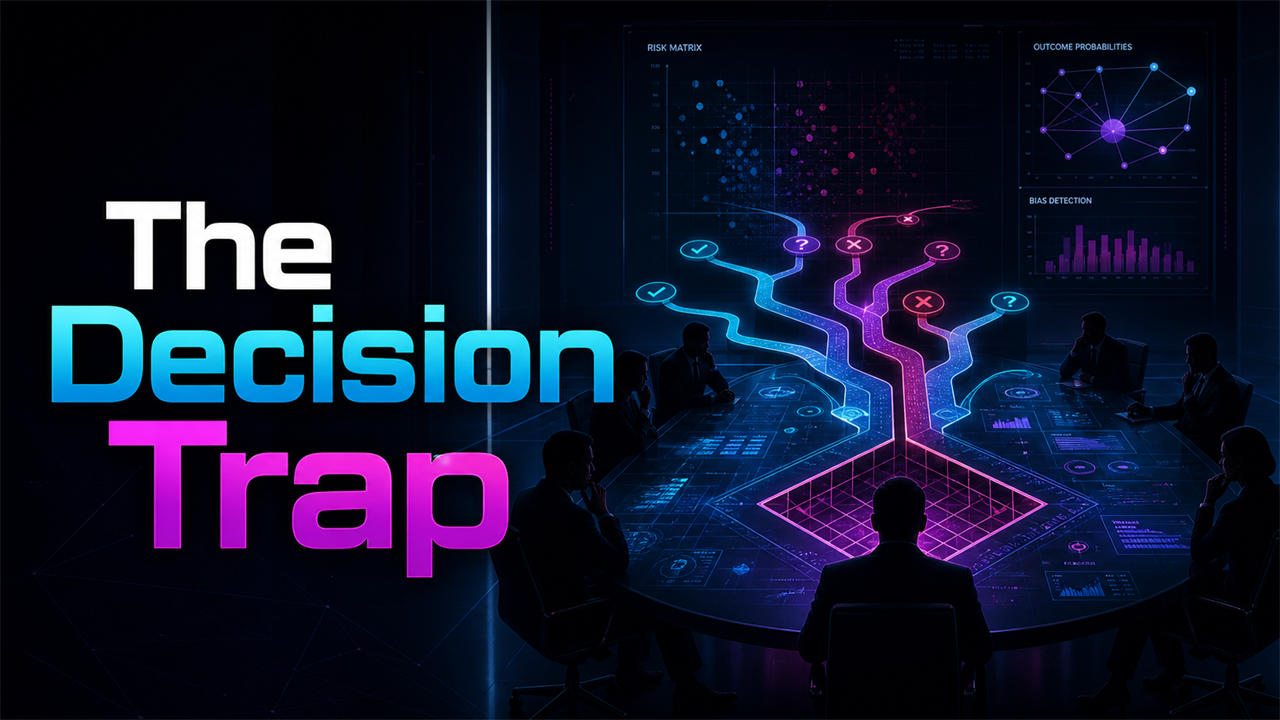
DECISION ARENA - 13 ROUNDS
BEHAVIORAL DECISION SIMULATION
The Decision Trap
When Judgment Gets Captured
A behavioral decision-making simulation revealing how biases, assumptions, incentives, and pressure distort judgment inside real workplace choices.
Bias Under Pressure
Expose the mental shortcuts that feel logical in the moment.
Live Voting
Force debate between speed, evidence, politics, and risk.
Decision Hygiene
Practice moves that improve judgment before commitment hardens.
Round 1
The Confident Forecast
A senior leader predicts 40 percent growth next quarter because "the market feels ready." The data team has only weak evidence.
What should the team do before accepting the forecast?
Confidence often gets mistaken for accuracy. Strong decision makers separate conviction from evidence and ask what would change the forecast.
Round 2
The Sunk Cost Launch
A product has missed targets twice, but the company has already spent a year and a large budget building it.
Which decision frame is healthiest?
Sunk cost bias makes past investment feel like a reason to continue. The business principle is to decide from future value, not historical pain.
Round 3
The Loudest Room
In a strategy meeting, two executives dominate the discussion. Quieter functional experts disagree but do not speak up.
How should the facilitator intervene?
Group decisions are shaped by status and airtime. Good process protects information that hierarchy would otherwise suppress.
Round 4
The Urgent Shortcut
A client threatens to leave unless a risky customization is approved by Friday. Sales wants an immediate yes.
What is the best next move?
Urgency narrows attention and makes the visible loss feel larger than hidden downstream costs. Slow the frame before speeding the action.
Round 5
The Confirmation Hunt
A manager loves a vendor and asks the team to "find proof this is the right partner."
What should the team test first?
Confirmation bias turns analysis into advocacy. Decision quality improves when teams deliberately look for reasons their preferred answer may be wrong.
Round 6
The Average Customer Myth
Research shows mixed customer needs, but leadership wants one simple strategy for the "average customer."
Which response creates the best debate?
Averages can hide meaningful differences. Strategic decisions often improve when teams identify which customer, market, or use case they are truly choosing for.
Round 7
The Expert Halo
A famous consultant recommends a major operating model change after only three interviews.
How should leaders use the recommendation?
Authority bias makes borrowed certainty attractive. Experts add value, but leaders remain accountable for context, trade-offs, and implementation reality.
Round 8
The Risk Reversal
The team is afraid to change a failing process because the change might create visible disruption.
Which question reframes the decision?
Status quo bias makes inaction feel neutral. In business, doing nothing is also a decision with costs, risks, and owners.
Round 9
The Incentive Trap
A team is rewarded for quarterly volume, but the proposed decision may damage customer trust next year.
Which lens should guide the vote?
People rarely make neutral decisions inside misaligned incentives. Leadership must inspect what the system is rewarding before judging behavior.
Round 10
The Data Theater
A beautiful dashboard supports a recommendation, but nobody can explain how two key metrics were calculated.
What should happen before approval?
Presentation polish can create false certainty. Decision leaders should test metric integrity before allowing visual confidence to substitute for understanding.
Round 11
The Blame Forecast
A risky decision could succeed, but managers fear being blamed if it fails. Everyone quietly favors the safest option.
What should leadership clarify?
Accountability without psychological safety encourages defensive choices. Teams take better risks when they know how intelligent failure will be judged.
Round 12
The Last-Minute Pivot
On the eve of approval, a competitor announces something similar. The team wants to abandon the plan and pivot immediately.
What should the room do first?
Availability bias makes recent information feel disproportionately important. A new event should update assumptions, not automatically replace the whole strategy.
Round 13
The Final Trap
After two hours of debate, the team chooses the option that offends the fewest stakeholders, even though nobody believes it will win.
What is the leadership move?
Consensus can become avoidance. Strategic leadership means distinguishing real alignment from a low-conflict decision that lacks conviction.
Final Learning Summary
Better Decisions Need
Better Decision Conditions
The key lesson: bad decisions often look reasonable because pressure, hierarchy, incentives, and bias distort the room before the choice is made. Practical application: define the decision, test assumptions, invite dissent, and separate evidence from confidence. Strategic takeaway: decision quality is not a personality trait; it is a process leaders can design.
Key Lesson
Pressure makes shortcuts feel like judgment.
Application
Use disconfirming evidence, clear owners, and premortems.
Takeaway
The room decides before the vote does.
1 / 15