
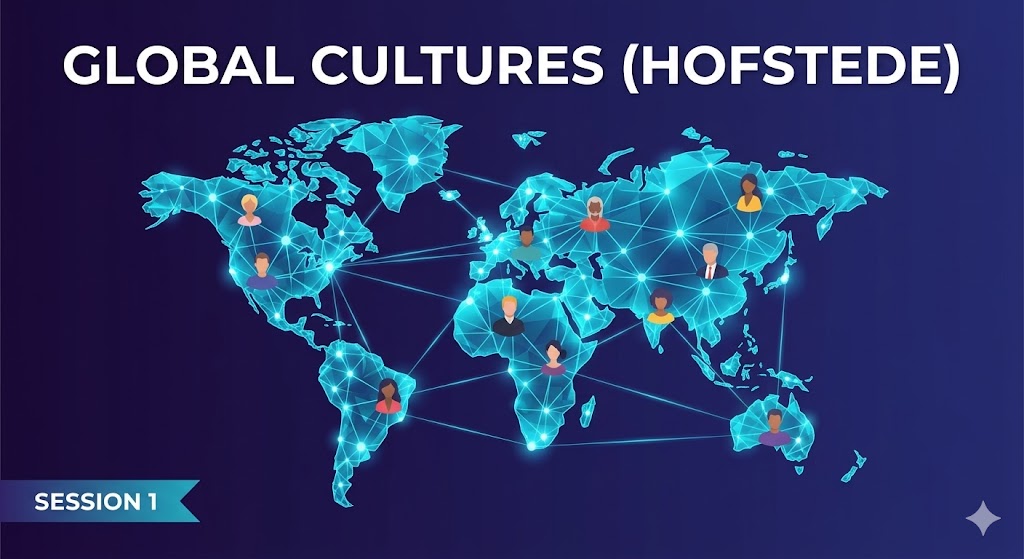
Interactive 60-minute session
Hofstede Battle Arena
Dark · Vibrant · Aurora Borealis · Crowd-powered showdown across 6 cultural dimensions
Introduction
Who was Geert Hofstede?
Geert Hofstede (1928–2020) was a Dutch social psychologist and management thinker who pioneered the study of how national culture shapes workplace behavior.
While at IBM in the 1960s–70s, he surveyed over 116,000 employees across 50+ countries — one of the largest cross-cultural studies of its time.
He identified recurring patterns that became the 6D model: a framework used today in global leadership, negotiations, and team design.
Key message: these are national tendencies, not individual destiny. Use them as conversation starters, not labels.
A common language for comparing hierarchy, risk, identity, and time across cultures.
National scores describe broad tendencies. Teams, industries, and people vary widely.
Introduction
The 6 Cultural Dimensions
Who is more comfortable with visible hierarchy and unequal authority?
Who is more comfortable saying "I own this decision" versus "we decided together"?
Which culture leans more toward competition, achievement, and winning?
Who is more likely to demand structure, rules, and a clear process plan?
Who is more likely to sacrifice short-term wins for a 5-year payoff?
Who more openly allows enjoyment, leisure, and personal self-expression?
🎮 Game rule: each battle shows a country pair and a dimension question. Audience votes first — hands up — then the facilitator clicks Reveal. The answer panel, bouncing checkmark, animated bars, score counters, and insight all appear on the same slide.
40-Minute Main Event
25 Head-to-Head Country Battles
Vote · Reveal · React · Debrief · Repeat. ~90 seconds per battle fills the full 40-minute game block.
Battle 1 · 👑 Power Distance
Denmark vs Russia
"Who is more comfortable with visible hierarchy and unequal authority?"
Higher score = more hierarchy acceptance, title sensitivity, and top-down decision norms.
Battle 2 · 🙋 Individualism
USA vs China
"Who is more comfortable saying "I own this decision" versus "we decided together"?"
Higher score = stronger individual voice, personal accountability, and direct ownership.
Battle 3 · 🏆 Masculinity
Japan vs Sweden
"Which culture leans more toward competition, achievement, and winning?"
Higher score = more emphasis on competition, performance, and visible status from success.
Battle 4 · 📋 Uncertainty Avoidance
Japan vs Singapore
"Who is more likely to demand structure, rules, and a clear process plan?"
Higher score = stronger preference for rules, predictability, and structure under ambiguity.
Battle 5 · ⏳ Long-Term Orientation
Nigeria vs China
"Who is more likely to sacrifice short-term wins for a 5-year payoff?"
Higher score = more patience, pragmatism, and investment in long-run adaptation.
Battle 6 · 🎉 Indulgence
Japan vs Mexico
"Who more openly allows enjoyment, leisure, and personal self-expression?"
Higher score = more openness to enjoying life, leisure, and expressing personal wants.
Battle 7 · 👑 Power Distance
Netherlands vs India
"Who is more comfortable with visible hierarchy and unequal authority?"
Higher score = more hierarchy acceptance, title sensitivity, and top-down decision norms.
Battle 8 · 🙋 Individualism
UK vs South Korea
"Who is more comfortable saying "I own this decision" versus "we decided together"?"
Higher score = stronger individual voice, personal accountability, and direct ownership.
Battle 9 · 🏆 Masculinity
Mexico vs Finland
"Which culture leans more toward competition, achievement, and winning?"
Higher score = more emphasis on competition, performance, and visible status from success.
Battle 10 · 📋 Uncertainty Avoidance
France vs UK
"Who is more likely to demand structure, rules, and a clear process plan?"
Higher score = stronger preference for rules, predictability, and structure under ambiguity.
Battle 11 · ⏳ Long-Term Orientation
South Korea vs Australia
"Who is more likely to sacrifice short-term wins for a 5-year payoff?"
Higher score = more patience, pragmatism, and investment in long-run adaptation.
Battle 12 · 🎉 Indulgence
UAE vs Sweden
"Who more openly allows enjoyment, leisure, and personal self-expression?"
Higher score = more openness to enjoying life, leisure, and expressing personal wants.
Battle 13 · 👑 Power Distance
UAE vs Israel
"Who is more comfortable with visible hierarchy and unequal authority?"
Higher score = more hierarchy acceptance, title sensitivity, and top-down decision norms.
Battle 14 · 🙋 Individualism
Australia vs Brazil
"Who is more comfortable saying "I own this decision" versus "we decided together"?"
Higher score = stronger individual voice, personal accountability, and direct ownership.
Battle 15 · 🏆 Masculinity
Denmark vs Germany
"Which culture leans more toward competition, achievement, and winning?"
Higher score = more emphasis on competition, performance, and visible status from success.
Battle 16 · 📋 Uncertainty Avoidance
Singapore vs Russia
"Who is more likely to demand structure, rules, and a clear process plan?"
Higher score = stronger preference for rules, predictability, and structure under ambiguity.
Battle 17 · ⏳ Long-Term Orientation
Japan vs Nigeria
"Who is more likely to sacrifice short-term wins for a 5-year payoff?"
Higher score = more patience, pragmatism, and investment in long-run adaptation.
Battle 18 · 🎉 Indulgence
China vs Nigeria
"Who more openly allows enjoyment, leisure, and personal self-expression?"
Higher score = more openness to enjoying life, leisure, and expressing personal wants.
Battle 19 · 📋 Uncertainty Avoidance
Germany vs Mexico
"Who is more likely to demand structure, rules, and a clear process plan?"
Higher score = stronger preference for rules, predictability, and structure under ambiguity.
Battle 20 · 🙋 Individualism
France vs Netherlands
"Who is more comfortable saying "I own this decision" versus "we decided together"?"
Higher score = stronger individual voice, personal accountability, and direct ownership.
Battle 21 · 🏆 Masculinity
Sweden vs Italy
"Which culture leans more toward competition, achievement, and winning?"
Higher score = more emphasis on competition, performance, and visible status from success.
Battle 22 · 👑 Power Distance
India vs Israel
"Who is more comfortable with visible hierarchy and unequal authority?"
Higher score = more hierarchy acceptance, title sensitivity, and top-down decision norms.
Battle 23 · ⏳ Long-Term Orientation
USA vs South Korea
"Who is more likely to sacrifice short-term wins for a 5-year payoff?"
Higher score = more patience, pragmatism, and investment in long-run adaptation.
Battle 24 · 🎉 Indulgence
Brazil vs Russia
"Who more openly allows enjoyment, leisure, and personal self-expression?"
Higher score = more openness to enjoying life, leisure, and expressing personal wants.
Battle 25 · 📋 Uncertainty Avoidance
Finland vs Turkey
"Who is more likely to demand structure, rules, and a clear process plan?"
Higher score = stronger preference for rules, predictability, and structure under ambiguity.
Closing
What to take away
They help you ask smarter questions; don't replace curiosity about the actual person in front of you.
Shift meeting style, feedback framing, and decision pace without becoming fake.
Hierarchy vs equality · Individual vs group · Rules vs flexibility · Now vs later.
The best cross-cultural move: "How would this usually be handled on your side?"