
COMMUNICATION ARENA - 13 ROUNDS
EXECUTIVE COMMUNICATION SIMULATION
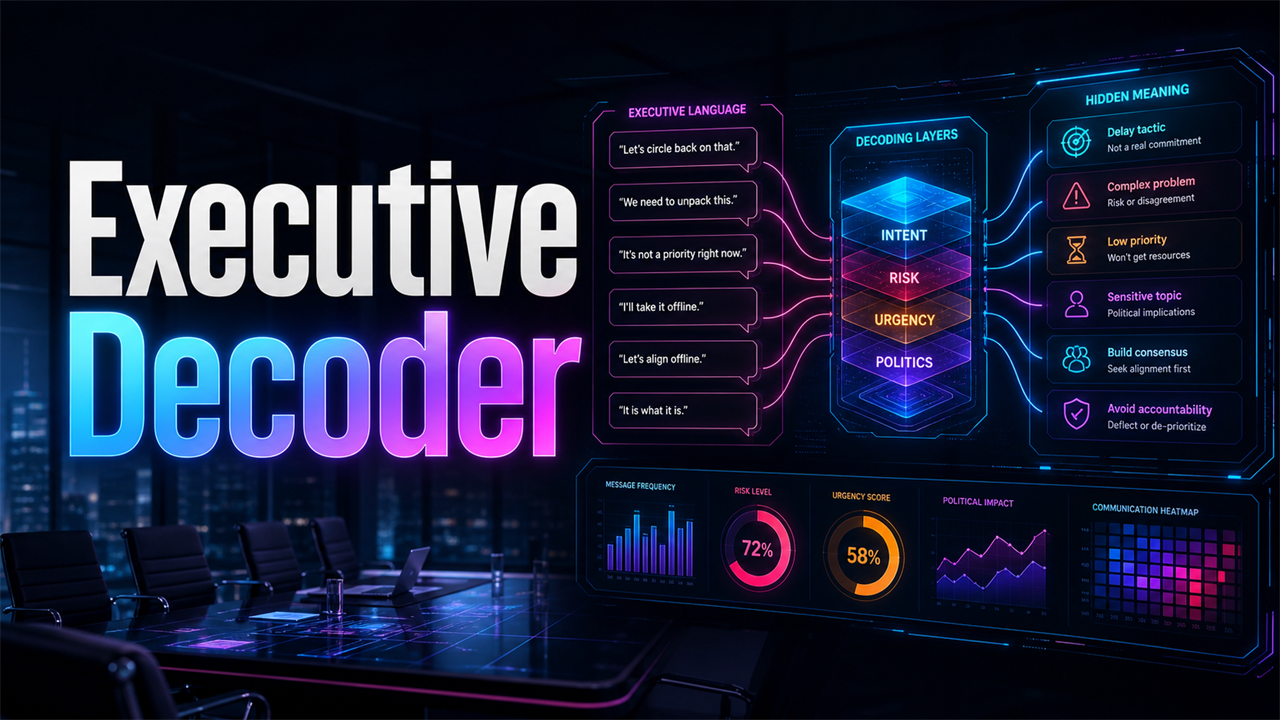
Executive Decoder
Read Between The Lines
A workplace communication simulation where participants decode executive language, hidden meanings, strategic messaging, ambiguity, and organizational signals.
Coded Language
Translate phrases that carry strategy, risk, and politics.
Audience Voting
Compare interpretations before revealing the leadership lesson.
Signal Reading
Learn when to clarify, escalate, act, or wait.
Round 1
"We Need More Discipline"
An executive says this after reviewing spending, hiring, and project delays. Different teams hear very different warnings.
Executive language is often compressed. Good teams decode the domain, urgency, and expected behavior before overreacting.
Round 2
"This Needs Ownership"
A cross-functional issue keeps slipping. The phrase lands in a meeting where everyone already thinks they are doing their part.
Ownership language usually signals blurred decision rights. The business lesson is to clarify who decides, who executes, and who supports.
Round 3
"Let's Be Pragmatic"
A leader says this during a debate between a bold strategic plan and a safer short-term compromise.
Pragmatism can mean wisdom or risk aversion. Decoding requires asking which constraint is real: time, money, trust, capability, or politics.
Round 4
"Interesting Direction"
A senior executive uses this phrase after a team presents a proposal. The team cannot tell whether it is approval, doubt, or polite dismissal.
Ambiguous praise can stall teams. Strong communicators convert vague reactions into explicit next steps and decision criteria.
Round 5
"We Are Watching This Closely"
The phrase appears in a company update about a troubled region. Employees wonder if major changes are coming.
Monitoring language signals uncertainty without commitment. Leaders should pair it with thresholds that trigger action.
Round 6
"Simplify The Story"
A team removes nuance from a complex recommendation, making the final message easier to understand but less honest.
Executive clarity should not erase decision-critical complexity. The skill is separating noise from essential nuance.
Round 7
"No Surprises"
The phrase is repeated before a major client rollout. Teams disagree on what must be escalated early.
No surprises means risk visibility, not noise. Teams need escalation criteria before issues become political.
Round 8
"The Board Is Asking"
A request suddenly gains urgency because it is tied to board attention. Teams scramble without knowing the real question.
Authority references can create urgency without clarity. Decode the actual decision, concern, or risk behind the request.
Round 9
"We Need To Raise The Bar"
After missed goals, executives use this phrase across performance, product quality, and leadership behavior.
Aspirational phrases require operational translation. Without examples and measures, teams invent different bars.
Round 10
"Take This Offline"
A heated topic is moved out of a leadership meeting. Some assume the issue is sensitive; others think it is being buried.
Moving offline can focus the meeting or hide conflict. Trust depends on visible ownership and a return path.
Round 11
"We Need A Step Change"
The company is under pressure. Teams debate whether this means incremental improvement, restructuring, or a new operating model.
Magnitude words need translation. A step change should define scale, timeline, non-negotiables, and acceptable disruption.
Round 12
"Let's Align First"
A decision is delayed for alignment, but the team suspects leaders are avoiding conflict.
Alignment can mean shared commitment or polite avoidance. Decoding requires identifying the unresolved trade-off.
Round 13
"Be More Strategic"
A manager receives this feedback after presenting a detailed execution plan. They leave unsure what to change.
Strategic often means connecting choices to outcomes, trade-offs, risks, and competitive context. Good feedback makes that expectation explicit.
Final Learning Summary
Decode Before
You React
The key lesson: executive language is compressed by time, politics, and hierarchy. Practical application: clarify intent, scope, urgency, owner, and decision criteria before acting. Strategic takeaway: organizations move faster when hidden meaning becomes explicit action.
Key Lesson
Ambiguity becomes work, fear, or delay.
Application
Ask what changes, who owns it, and by when.
Takeaway
Clear decoding protects speed and trust.
1 / 15